Showing posts with label Zack Kotzer for Motherboard. Show all posts

Monday, 30 January 2017

'Doom' Combined With 'SUPERHOT' Is the Ultimate Shooter

Doom II, a good game about shooting big honkin’ demons, was released in 1994 and has remained relevant to this day thanks to video game modders who keep creating new content and tinkering with it in interesting ways. SUPERHOT, a high-concept shooter where time only moves when the player moves, was released in 2016, and was one of our favorite games that year. Is it possible, dear reader, that these two good things could be combined, using technology, into a singular good thing? One modder is out there trying to find out, splicing Doom II and SUPERHOT into… TwoHot!

I mean SuperDoom!

“The goal of the project is to fuse Doom and SUPERHOT,” says modder LudasRedard bluntly enough in a proposal video.

In the mod’s demonstration, LudusRedard shows what he's done so far. The aesthetic alterations are clear. The Imps’ sprites remain the same but their surroundings resemble SUPERHOT’s endless white gallery spaces. More impressively, bullets can now be seen when fired, and while the time manipulation as it exists in SUPERHOT has yet to be implemented, for demonstration purposes the modder can freeze time to show those red piping hot bullets linger in the air. According to the mod’s to-do list, LudusRedard would also like to create the ability to throw weapons at enemies, one of the maneuvers SUPERHOT has to get out of its many tight binds.

“I’d also like to add that even if the mod becomes abandoned or is unfeasible, I will still release what assets I do make prior to the abandonment regardless,” said LudusRedard.

A Brutal Doom compatibility patch also appears to be on the table.

Get six of our favorite Motherboard stories every day by signing up for our newsletter.


from 'Doom' Combined With 'SUPERHOT' Is the Ultimate Shooter

Sunday, 22 January 2017

New Exhibit Celebrates the Lost Art of the Screensaver

Long before “let’s play” videos had us watching someone else play a video game, we watched a Windows computer navigate a Wolfenstein 3D-looking maze. If you touched it, it would vanish. It was, after all, a screensaver, not something that you see often these days, and an artistic medium worth celebrating according to Dutch digital artist Rafaël Rozendaal.

“Screensavers are like a moving painting,” Rozendaal told me in a Skype call from Utrech in the Netherlands. “It’s almost as if they were made for a museum. They’re purely digital images, so they’re designed to show what a computer will do. They don’t overdo it, they have very simple parameters. They aren’t storytelling.”

Rozendaal is curating a gallery of 27 screensavers in a way they’ve never been seen or appreciated before. The show is called Sleep Mode. Four of the oldest screen savers will be on their native machines, for context, but most will be blown up along the large space provided by Rotterdam’s Het Nieuwe Instituut (New Institute). Rozendaal has also put together an audio tour and an online collection of interviews with the people who created the screensavers etched into the back of your brain.

One thing those programmers emphasized, according to Rozendaal, is that these screensavers are not films or animations, but procedurally generated design pieces, a living mobius strip created for the simple purpose of stopping your monitor from burning its own image into itself.

Image: Rafaël Rozendaal

The screensaver was created and coined by software developer John Socha. Socha was tired of having to turn his green-screened IBM off manually, so he wrote a simple piece of code, scrnsave, to switch the screen to black after three minutes of idling. This basic program is one of the four that will be on its original machine in the gallery.

Sleep Mode will feature a lot of classics. The 3D pipes. The flying toasters. As well as “Mystery,” which I called haunted house and liked to use seasonally. Rozendaal believes screensavers became so popular in their day because for a while, and for so many, they were one of the few fun and creative things to do on a personal computer. Enthusiasm became momentum, and that momentum, according to Rozendaal, fuels everything in technology, from Apple products to social networks.

In the 90s, people got enthusiastic about what image would display on their computer when they left the room, and that’s why they could buy virtual aquarium CDs in the same supermarket they bought milk.

Rozendaal’s favourite screensaver is the “starfield.” A randomly generated and constantly growing journey through cosmic lights. It’s Star Trek sensibilities easily appealed to nerds of its time. Rozendaal likes its simple, elegant code, a few tricks of spatial light and script that made him feel like he was “being sucked into the screen.”

“The limitations of these computers created a unique language,” said Rozendaal. “Motion graphics and games are hyperrealistic, that’s less interesting to me. I’m interested in forced abstraction. In painting abstraction is there as a luxury, but in computers abstraction was a necessity.”

Sleep Mode will run from January 27 until June 25.


from New Exhibit Celebrates the Lost Art of the Screensaver

Saturday, 14 January 2017

Super Mario Isn't a Human Being

It’s a thought that’s crossed my mind on several occasions. If Super Mario is an Italian plumber, then where in relation to the Mushroom Kingdom is Italy? If I took out a globe could you show me? Could you trace your finger between the two? From where this thumb-sized man battles dragons and ghosts to a small farm in Campania where a tiny nonna weeps and wonders where her boys have gone. On Thursday night, during the Switch presentation, Nintendo shattered my perception of who and what Mario is, and has left me shaken ever since.

While the game lineup for the Nintendo Switch’s launch is a little slim, the year ahead is made up of some big swingers. A new, expansive Zelda, a swift follow-up to Splatoon, and a brand new Super Mario Odyssey. Odyssey will take Mario to worlds outside the Mushroom Kingdom, including a misty forest and a desert villa. But none are disturbing as “New Donk City,” a Sesame Street style reduction of New York City. New Donk City, you see, is full of humans. Plain-clothed, everyday humans. And they look nothing like Mario. That is painfully clear when you see Mario walk next to them:

Image: Nintendo

Clearly, the figure on the left is an anatomically modern human. The figure on the right, by contrast, is something else.

The invasion of Bowser and Mario into New Donk City seems like an interruption. There aren’t googly eyed platforms and death traps scattered about the streets that are so common to Mario’s challenging days. There are mortal obstacles like yellow cabs, open manholes, and the ultimate monsters: other people. Those other people all have regular faces, eyes of an average size, noses of an average size, and average heights. They appear to have various races and hair colors.

But those humans, those conventional humans, are a sharp contrast to Super Mario, who is a pudgy red firecracker of color who can’t be bigger than a Cabbage Patch Doll and can stand comfortably atop a streetlight. Prior to this upsetting revelation, we were left to imagine what Mario's homeworld looked like based on evidence in the games. Mario, Luigi, Princess Peach, and other humanoid-seeming beings all share a certain body type, so one could assume that people from Italy, Brooklyn, or wherever Mario came from, looked approximately the same. We could assume their odd bodies were just a stylistic choice Nintendo made. Now it is clear that this is not the case. Mario and his better-looking brother Luigi are aberrations.

Is Mario an offshoot? A Mushroom Kingdom splinter of evolution? Are there detrimental side effects to living in the fantasy world for prolonged spans of time? Is his entire origin story a lie he told Princess Peach? And who is this royal lineage of humanoids making subjects out of the simple Toads, who can be found as messengers, servants, and shopkeepers (though recent endeavors into “archeology” promises there is at least some class mobility among the entire species).

Mario has had a human job (plumber) at least since since ‘83 in our timeline, though he attempted a multitude of other careers over the years. Mario has hair, as Odyssey shows us clearly. He certainly doesn't appear to be a fungus from the Mushroom Kingdom, like Toad, who's as rubbery and nude as a sphinx cat. In Super Mario World 2: Yoshi’s Island, players escorted an infant Mario, intercepted from the stork by the wizard Kamek, who was on his way to—we always assumed—Italy or America. The co-existence of Mario and Baby Mario in games like Mario Kart have suggested certain time paradoxes are possible, but I digress.

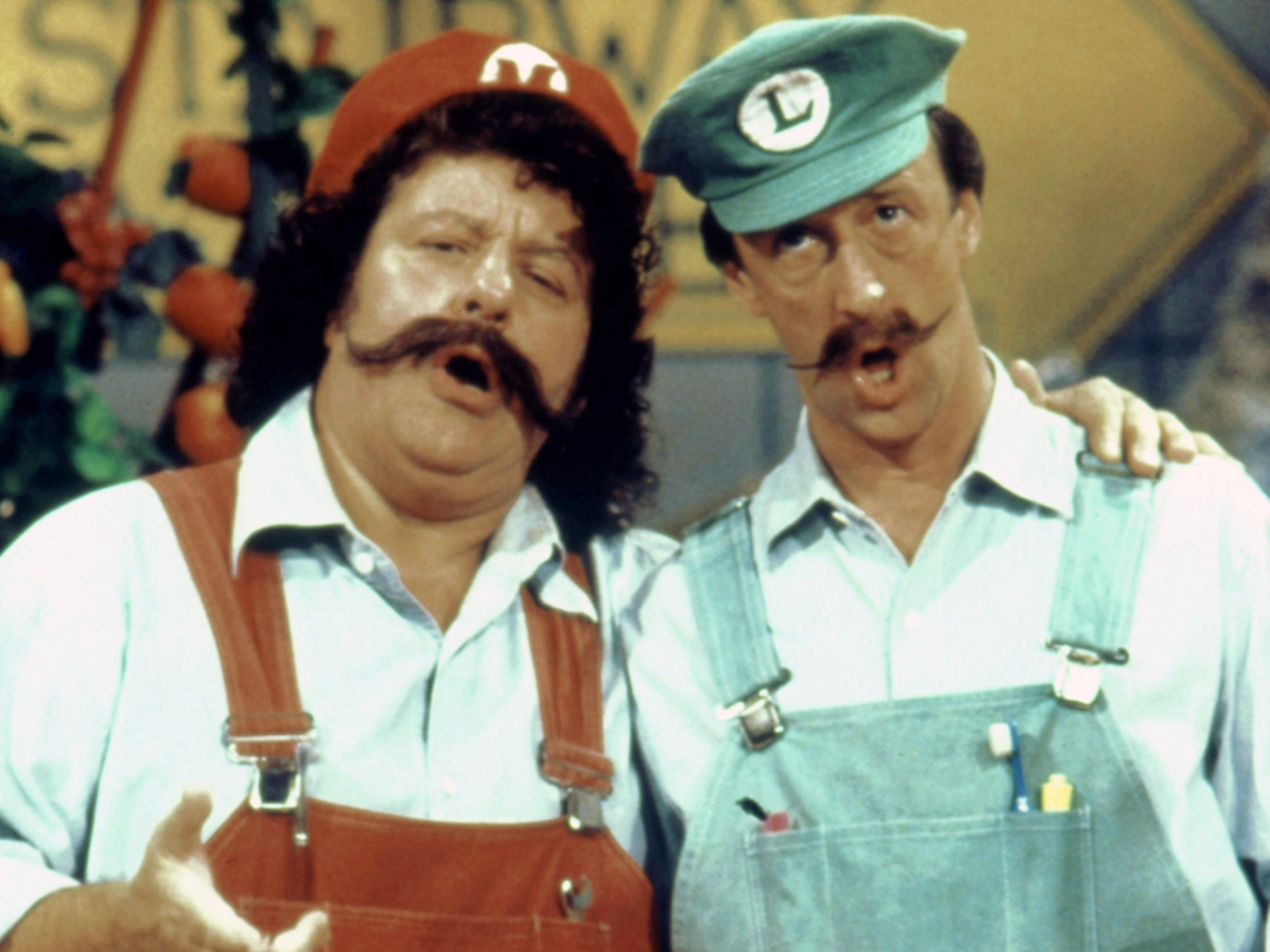
In other types of media, Mario has always been played by a human as a human. By the late, great Bob Hoskins in the 1993 cyberpunk fantasy thriller Super Mario Bros., and by the late, great Captain Lou Albano in 65 episodes of The Super Mario Super Show. In both cases, a main part of the plot was that the Mario brothers were looking for the way home, the green pipe that would return them to Brooklyn. Likewise, general appearances by the real world and anthropological history occur in adventures a little left of the Mario canon, such as Mario’s Time Machine and Mario is Missing, where you mill about a quiet San Francisco or annoy Benjamin Franklin while he flies that kite. The Mario brothers have also participated, repeatedly, in the Olympic games, but they have always been joined by Sonic the Hedgehog and his moody friends, so it’s fair to assume those games exist in a pocket of pure chaos.

I feel sick. Image: Nintendo

I always assumed it was cartoon-land logic that excused Mario from some scientific principles. For example, Super Mario Galaxy showed us that Mario can breathe in the vacuum of space, but still succumb to suffocation underwater. Mario’s main source of income and upgrades comes from smacking his soft head against metal boxes and piles of bricks, which would have turned the normal human’s brains into mush through repeated concussion. Then again, Mario’s only capable of stringing four words together at a time, though now it isn't clear if this is due to brain damage, or that this creature, whatever it is, simply can't wield complex language.

It’s clear now, more than ever, that after a lifetime of Mario there’s still a lot we don’t know him it.

What's most distressing about this news is that if Mario is not of Italian descent, then what is that a-patronizing voice he’s been a-subjecting us to for years? Mario is not human, and Mario is a-hiding something.

All that said, Super Mario Odyssey looks really fun and I want to play it as soon as possible.

We have reached out to Nintendo for comment, but it did not respond in time for publication.


from Super Mario Isn't a Human Being

Tuesday, 27 December 2016

17 Games We Want to Play in 2017

Well my gaming friends, what a year it has been. No Man’s Sky actually came out. The Last Guardian actually came out. The Witness actually came out. Final Fantasy XV, lord even Final Fantasy XV, actually came out. 2016 was the year video games actually came out! Well... not all of them. Cuphead, Yooka-Laylee, Horizon: Zero Dawn, Nier: Automata and Tacoma didn’t come out. They were delayed until 2017 despite (if not entirely in spite of) being in our “16 Games to We Want To Play in 2016” list, joining Persona 5, from our 2015 list, which, likewise, hasn’t come out.

No sense getting hung up in the past, fellow game playing people. On top of those late to the party, there are even more video games to get hot and bothered about that may just come out in the new year! Here are 17 of those games pencilled in for 2017. And perhaps 2018. 2019. 2025. 2080. After I die and my bones have turned to dust.

Image: Nintendo

The Legend of Zelda: Breath of the Wild

Nintendo is hitting 2017 with a double shot in its drink: a new and conceptually intriguing Nintendo console, the Switch, mixed with a new and conceptually intriguing Legend of Zelda. Drink it up! Taking inspiration from the likes of Dark Souls, Skyrim, and Ghibli films, Breath of the Wild is set in an expansive Hyrule that allow players to find their own way to besting that cheeky asshole Ganon yet again. It also adds crafting. And reintroduces JUMPING. Geeze. While it seems like a steep departure from Nintendo’s most tried and true formula, so did Wind Waker and Majora’s Mask. So this mmmmiiiight just be something fantastic.

Image: Arkane Studios

Prey

First Prey was an Art Bell-inspired sci-fi shooter from 3D Realms about a Native man being abducted by aliens and blasting his way out of a gruesome spacecraft. Then Prey returned, lead by Bethesda, as a seemingly open world project about an abducted US Marshal starting life anew as an alien bounty hunter. That was cancelled. Prey is back, again with Bethesda, now more unrecognizable than ever. Swapping X-Files for Twilight Zone, and Prey for System Shock for that matter, this Prey centers around an astronaut having an extremely strange day aboard an old space station, fighting against aliens that can disguise themselves as everyday objects. Think Decepticons whose specialty are desk fans. This Prey is being handled by Dishonored creators Arkane Studios, so even if it’s radically different from its predecessor, it seems like everyone’s going to win. Except for 3D Realms. They don’t win. That’s kind of the norm.

Image: Rockstar Games

Red Dead Redemption 2

Rockstar’s western Red Dead Redemption gave us an expanse, the feel and the grit of taming a steed and riding it into the sunset, dueling with the various outlaws and corruption, watching the fury of the railroad as the “Wild West” buckled to modernity, glowing in the warmth of a strange, extinct and essential American chapter. Given all of that, I am willing to overlook the fact that the third game in the series is being called “Red Dead Redemption 2.”

Image: Amistech Games

My Summer Car

With Forza and Gran Turismo, it’s clear that the gearheads of the game world appreciate their realism, but so rarely do we get a game that portrays the average relationship with an automobile. My Summer Car is not about luxury. It’s about a brutally hot summer in Finland and the rustbucket jalopy you call your own. Having to maintain, invest in and, god willing, drive your car, you get to live through the most mindless season, dodging NPC drivers who are supposed to be drunk instead of merely acting like it.

Image: Capcom

Resident Evil 7

Resident Evil 4 changed the trajectory of survival horrors for a generation, but Resident Evil itself hasn’t changed at all since. Resident Evil 5 and 6, not unlike the undying Paul W. S. Anderson films, became entrenched in never ending action sequences and a storyline more brainless than the ghouls you fill with lead. Capcom seemed to take the hint from fans and critics that it was time to clear the table. Going first person with white-knuckling cramped environments, a bumpkin family horror that’s a mix of Texas Chainsaw with American Pickers, and gruesome 3D photography techniques, the upcoming and mysterious Resident Evil 7 seems like the frightful grossout players have been waiting for. Mind you, one that seems to be capitalizing on PT’s adoration, but that game doesn’t exist anymore, giving Resident Evil 7, a game that does exist, the upper hand.

Image: Finji

Night in the Woods

An anticipated “rust belt gothic” tale about sad cats, midnight mysteries and donuts, Night in the Woods takes a refreshingly Love and Rockets approach to adventure games. Centering around Mae’s return to her small and shrinking home town, moving back in with her parents after dropping out of life, Mae discovers a supernatural element to her old haunts. She’ll have to juggle the paranormal with the anxiety of a directionless future. You’ll also get to smash some fluorescent light tubes with the rest of the cool kids for once!

Image: Ebb Software

Scorn

Between Doom, Dark Souls III, Devil Daggers, and Thumper, it seems like some of 2016’s greatest offerings were about relentless trips to Hell. Personally, I see no reason for this trend to end next year, or beyond! The most promising and brutal looking vacation to the twisted netherworld is Scorn, a grotesque Serbian horror game with no shortage of authentically Giger-y dread. In it you navigate through a forsaken world with weapons and puzzles that all seem wretchedly organic, perhaps the closest we’ve come to the game Jennifer Jason Leigh created in eXistenZ. It should pair nicely with Agony, a game I admittedly keep mistaking for Scorn, about a soul hopping from form to form looking for a way to get the Dodge outta Hell.

Image: Mode 7

Tokyo 42

From Mode 7, the publishers of the cult Frozen Synapse series, comes an especially vibrant looking action game. Seemingly a combination of Monument Valley and the old Syndicate games, Tokyo 42 peers down from above at a busy and colourful metropolis that is by no means free from dark shenanigans. From rooftop to rooftop, you engage in all kinds of shadiness in broad daylight, plucking off targets and making your escape through a city in the clouds.

Image: BioWare

Mass Effect: Andromeda

It was never a question of if Mass Effect was going to make a return but when, and that when is 2017. Inside the Mass Effect universe, it has been much longer, 600 years give or take. The descendants of the N7 forces now have a new frontier to explore, the Andromeda galaxy, full of quests, danger and, if you’re at all like my social media circles, new alien species to imagine kissing.

Image: JP LeBreton

Autobiographical Architecture

It may have been a big year for Doom, but JP LeBreton has a lifetime with the game to share. An autobiography of the BioShock level designer in the form of a Doom II mod, Autobiographical Architecture seems to be a humbling experience unlike any other, and one that should prove fascinating in the new year.

Image: Sega

Sonic Mania

Don’t @ me, it’s true. Sonic has sucked since the 90s. After Sega tortured their needlemouse through embarrassment after embarrassment, the company has finally found the right folks to return Sonic to glory. Created by developers who sharpened their teeth with fan games, Sonic Mania looks like a shockingly authentic throwback to the good times of Sonic 2 and Sonic CD. I’m still reeling in excitement over the ‘Studiopolis Zone,’ a broadcast media-themed world that seems to have been cobbled together from Larry King’s old backdrops. Finally, an excuse to publish my Sonic x Marshal Mcluhan slash fiction.

Image: David OReilly

Everything

When David OReilly made a game called Mountain, it was about a mountain. A mountain that floated in the ether and spoke sometimes, other times getting hit by CDs and magician hats. For many, it became an obsession, watching their mountains in meditative states or hoping to view some of the floating rock’s deeper secrets. David O’Reilly’s next game, for PlayStation, is called Everything. It is about everything. Taking control of everything from the cosmic to the microscopic, the natural to the manufactured, and going on a metamorphic joyride. I wonder if that includes any mountains. I’d love a game about a mountain.

Image: Tales of Games

Barkley 2

I may have jinxed Persona 5’s release into a two year delay, but we couldn’t risk it with the most anticipated RPG of our generation. A sequel to Barkley, Shut Up and Jam: Gaiden, an FF7-style dystopian epic that rightfully replaced dreamy anime whine boys with Charles Barkley, LeBron, Jordan, Bird, and robo-Vince Carter, Barkley 2 sadly drops the legendary basketball men to avoid pissing off the NBA, but remains set in a world desolated by the Chaos Dunk. The new Barkley will feature an open world, the developers described the game as being similar to the Way of the Samurai series, where the secrets to the universe can only be unlocked with hoopz.

Image: Hollow Ponds

Loot Rascals

It’s wonderful that roguelikes, a once lonely genre, has received so much love in the last few years, but it doesn’t solve the issue that for many it’s still a confusing and intimidating thing to play. From the same charmers who made Hohokum comes a roguelike that seems to be the antidote to that problem. Visually translating the roguelike experience into something decipherable without becoming dull, simplistic or patronizing, the kooky space odyssey with looting-centric combat should reel in new fans and delight current roguelike rogues alike.

Image: QS GamesLab

Antariksha Sanchar

Despite a lack of training and dying in his early 30s, Srinivasa Ramanujan is considered one of most important mathematicians of the 20th century, plotting out infinite number series and number theory off gut instincts that were later confirmed to be true. Meanwhile, I rapidly approach the same age with a bachelor's degree and continue to write about video games. A point and click adventure mixing Ramanujan’s mind boggling contributions with Myst’s clockwork sensibilities, Antariksha Sanchar is looking like a vibrant game worth crunching.

Image: Daniel Mullins Games

The Hex

Pony Island was a novel meta-adventure through a demon-made video game you had to play your way out of. From the same creator, Daniel Mullins, comes The Hex, a new metafictional larf that takes place deep within the game, this time for the player who wishes Wreck-It-Ralph was more miserable. Set in a tavern where various heroes cool their heels, the barkeep informs his patrons that among them is a murderer (outside of their respective games, I assume, where these protagonists murder all the time). Now the group of adventurers must explore the stormy estate looking for clues before it’s game over and good night.

Image: YS Net

Shenmue III

A sequel that’s too surreal to believe is real, Shenmue is returning after a 16-year slumber. In its time, Shenmue was the most expensive game ever created (nearly fifty million), while the newest wrangled an otherwise impressive six million on Kickstarter. Shenmue III picks up where we left off on martial arts celibate Ryo Hazuki’s magical quest for vengeance against crime lord Lan Di. That naughty, dedicatedly old school Lan Di is still stirring up shit it seems, and now joined by a new femme fatale, Niao Sun. Sega has given creator Yu Suzuki full control over the third chapter since the money was crowdsourced, promising a Shenmue that ought to be completely insane.


from 17 Games We Want to Play in 2017

Thursday, 8 December 2016

I Played Justin Trudeau’s Hockey Video Game and It Was Eh

JT Hockey.jpg

Welcome to a place I call Hockey Hell. Image: Code.org

Canadian prime minister Justin Trudeau made a video game. I couldn’t tell you the exact amount of time he spent developing it. Games these days can be made over a weekend, or half of their demographic’s lifetime, but I’d wager it didn’t take him too long. Trudeau made the game earlier this week at Shopify’s Ottawa office, during an event called Hour of Code, which promotes computer programming education.

The game doesn’t appear have a name. It’s a hockey game.

Unlike Electronic Arts’ NHL 17, Trudeau’s hockey game does not feature career campaign modes, fantasy drafts, or licensed teams and real-world player likenesses. Unlike Mutant League Hockey, the 1994 Sega Genesis game, it does not feature mutants. Trudeau’s hockey game features a single mode with a hockey stick (yours), a net (your opponents’), and pucks. An incomprehensible amount of pucks.

Every time the puck scores against you, two more spawn in its place, like some kind of hockey hydra

Essentially one-half air hockey and one-half Pong, the objective is to smack a puck into the net in front of you. If you miss, the puck will bounce back. Floating from side to side, as a puck would in a one-player game of air hockey, you might watch your puck graze the edge of the net without actually nestling in it, like the infuriating DVD player logo that refuses to place itself into the corner.

Where Justin Trudeau’s hockey game falls apart, quickly, is that when a puck goes by you it’s considered a point for the opponent. That’s the Pong half. This alone would be a cruel way to conduct a sport, but it worsens. Every time the puck scores against you, two more spawn in its place, like some kind of hockey hydra.

This does not happen when you score a goal. Only in your own defeat. You can find the fun and grit of juggling a few pucks around, but there’s an inevitability you’re fighting against. Eventually there will be too many pucks. And those pucks will produce more pucks. Before you know it, the screen is full of pucks, and pucks will continue to create each other until the game crashes itself.

Read More: The Trudeau Government Took Flash Games Off the Prime Minister Website

I call this place ‘Hockey Hell.’ A swarm of the once-passing sound blips becomes a drone of noise. The slaps of the little pucks against the ice are now like the solid wall of clacks you feel from a pachinko parlour’s opening doors. The blows from the ref’s whistle become like the shrieks of birds arguing at dawn. The occasional applause from the crowd seems to mock you. They cheer because you’ve scored a goal, but that’s the last thing on your mind as the world drowns in cylinders that look like the cookie ends of an Oreo. As you are shooting from behind the centre line, perhaps this is a punishment for icing. Perhaps that was your sin.

“Coding is easy & anyone can try it,” tweeted Trudeau. “Check out the game I made today.”

Yes, anyone can try coding. I would agree that programming is worthwhile, but perhaps this is not the prime minister’s own calling.

Because the game was made using Code.org’s tools, you can tweak the game on your own, so maybe to start, you can try fixing the Canadian prime minister’s video game.

Get six of our favorite Motherboard stories every day by signing up for our newsletter.


from I Played Justin Trudeau’s Hockey Video Game and It Was Eh

Sunday, 4 December 2016

The World Still Sucks in ‘The Last of Us Part II’

After Naughty Dog made Sony a very, very happy video game company with their action packed Uncharted games, the studio began working on a gritty reboot of Jak and Daxter. That mutated into a far drearier, and far more satisfying post-apocalyptic epic called The Last of Us. Released in 2013, the game follows Joel and Ellie, survivors in a world overrun by a horrific fungal parasite that zombifies its victims, as the two make it across a desolated United States in hopes of developing a cure. While new franchises feel few and far between, The Last of Us was an instant critical and commercial hit, so of course it gets a sequel, announced today as ‘The Last of Us Part II’ instead of the far more logical ‘The Second Last of Us.’

When we last saw Joel and Ellie, at the end of their exhausting journey, their relationship was in uncertain terms and that still seems to be the case. In a small town overgrown with woodland, and tagged with the underground Fireflies’ energy-drink looking insignia, Ellie strums a soft guitar song over what appears to be a fresh corpse. Slightly older, Ellie swears revenge to Joel, against who is hard to say.

Shawn Layden, chairman of Sony International Entertainment and host of 2016’s PlayStation Experience, slipped the surprise reveal at the end of the keynote. He expressed that the game is still very early in development, a sentiment echoed by the game’s creator Neil Druckmann, who wrote a short blog post online. “It’s still early days for the project,” wrote Druckmann, “but we couldn’t wait any longer to give you a glimpse of what’s to come. We’re going to let the trailer speak for itself.”

So when The Last of Us Part II is due is hard to say. But what I can promise you are some very confusing ‘let’s play’ video posts. “The Last of Us Part II Part 8.” “The Last of Us Part II Chapter 12 Part Six.”

The mushroom apocalypse can’t come soon enough.


from The World Still Sucks in ‘The Last of Us Part II’

Crash Bandicoot's Jeans Look Super Realistic in Remastered Trilogy

20 years ago, Nintendo had Super Mario, Sega had Sonic the Hedgehog, and Sony found their equivalently marble eyed, good cardio cartoon mascot man. Naughty Dog (who would go on to make the blockbuster Uncharted series) introduced Crash Bandicoot, a neckless adventuring marsupial that loves whatever the heck “Wumpa Fruit” are and hates wooden crates. Taking the classic 2D platformer 3D in a more literal fashion, jumping around obstacles along zany corridors, the series quickly became PlayStation’s killer app. In 2017, Crash Bandicoot will be making a return in a remaster of the first three games, the ‘N. Sane Trilogy.’

Announced but not shown during E3 2016, Sony confirmed that Crash Bandicoot would be making some sort of comeback after the licence bounced around from Sony, to Vivendi Universal and now at Activision, who have been making a killing with Spyro through the Skylander series. At the PlayStation Experience event this weekend, fans finally caught a glimpse of what a new Crash Bandicoot looks like. It looks exactly like an old Crash Bandicoot, with more detailed hair and denim textures. Instead of a brand new adventure, the game recreates all the stages from Crash Bandicoot one through Warped.

Crash Bandicoot conquered the 90s, but how the same games might perform in 2017 will ride completely on nostalgia. The games haven’t aged as well as say, Super Mario 64, which has more meat on the bones, not to mention quantum mechanics. Crash is receiving the most extensive paint job, but not the only one. At the PlayStation Experience we also saw remasters of older franchises like Wipeout and Parappa the Rapper, showing a very sentimental year ahead for PlayStation 4 owners.


from Crash Bandicoot's Jeans Look Super Realistic in Remastered Trilogy

Monday, 14 November 2016

The Best NES Games Not Included in the 'Classic Edition'

Nintendo’s newest novelty doodad, a plug-n-play mini-console called the NES Classic Edition, is looking like a hit for the holidays. The $60 version of Nintendo’s first home console comes with 30 games that run on an emulator created in-house.

The games installed include both Nintendo classics like the Super Mario Bros. series, The Legend of Zelda, Donkey Kong, and Metroid, but also games from second party developers, such as Mega Man, Ninja Gaiden, and Final Fantasy. There are even some b-list classics like StarTropics, Tecmo Bowl and Bubble Bobble, balancing out a pretty formidable package.

It’s not the complete package, of course. Not every NES game is worth repurchasing—it had its fair share of true garbage—but many fans know the greatness of the NES stretched beyond its Mega Men and Marios. There are many games, famous and overlooked, that should be recognized for making the NES the powerhouse it was.

Here are a few games that you won’t find in the Classic Edition, and that ought to be part of the NES legacy despite being snubbed. More importantly, these are classics to the only person that matters: me.

Image: Capcom

Bionic Commando

In one of Capcom’s essential and frustrating action games, Ladd Spencer (more often known by his arcade name “Rad”) is sent to investigate and sabotage a facility run essentially by Nazis (literal Nazis before being localized). Spencer’s special weapon is an extending arm that can latch onto multiple surfaces, pulling him up to platforms or swinging dynamically through the air. The tradeoff is that Spencer cannot jump, only maneuver by swooping around like a spider caught in the breeze. I will say that the next time the government chooses a video game secret agent to infiltrate a base lined with normally pedestrian barrels, they should first consider anyone who can hop.

Image: Nintendo

Tetris

No I’m not pulling your leg, Tetris isn’t in the NES Classic Edition. Really, go look for yourself. See? That’s right. It’s not in there. Dr. Mario is in there. Tetris isn’t. I know there are hundreds of different ways to play Tetris, but the most desired will not be in Nintendo’s NES sendup. Letters of complaint will mount next to the hill of ones demanding Goku in Smash.

Image: Capcom

DuckTales

Capcom and Disney’s partnership made a lot of great games starring Mickey Mouse, Donald Duck, Aladdin. Even that Saturday morning cartoon that was essentially The Rescuers with a different pair of rodents, or the one where Balloo pilots a plane for some reason. None of them stood the test of time quite like DuckTales, where Scrooge McDuck travels the planet looking to increase his absurd amount of wealth. Scrooge uses his cane as both a golf club and a pogo stick. The memorable music and secret-littered levels made it not only a stand out for Capcom but the entire NES. Obviously its license is the main reason it’s not on the Classic Edition. A remake came out in 2013 with the cartoon’s cast reprising their roles. Alan Yonge, who voiced Scrooge and passed away earlier this year, was 93 at the time, so he sounds a little older than was probably intended, and you’ll feel a little older than you intended by proxy.

Image: Sunsoft

Blaster Master

Blaster Master, not to be confused with Master Blaster, is about Jason, a childhood idiot who lost his frog. Jason’s pet was drawn to a radioactive box, mutating the frog into a larger frog that then jumps down a massive hole. Jason chases the frog and discovers a power suit and a jumping all-terrain battle vehicle that he’ll use in an amazing adventure to save the companion he keeps in a small glass jar. Both the radioactive box and the giant adventure hole were mere meters away from Jason’s house. Jason leads a very interesting life.

Image: Sammy Corporation

Vice: Project Doom

If the box art that portrays a Ghanese movie poster Mel Gibson surrounded by fog, lightning, and steel beams wasn’t a tip off enough, Vice: Project Doom is an awesome action game. You play as a cop that uses a sword who discovers his city is being overrun by mutants and monsters. You travel through cities, jungles, sewers and castles to find the root of this conspiracy. The game opens with a car chase that leaves a highway full of innocent drivers in ruin. It may shock you to learn that the mastermind behind this doomsday plot spends most of the game standing by a large window and talking to himself. Take him out, heroes.

Image: Ultra Games

Base Wars

Yes, Tecmo Bowl has an inhuman Bo Jackson, but if you want one of the most memorable NES sports games starring overpowered athletes Base Wars is not only a good NES baseball game, but a baseball game with robots. Robots who use tread wheels, baseball cannons and scoop hands to make a joke out of America’s pastime. Plus sometimes the robots would fight with their bats and laser blades like this was a deadly cybernetic scrummage or hockey! A preview of an industrialized dystopia that’s decided humans aren’t even efficient enough to play their own sports!

Image: Rare

Battletoads

You know it. I know it. We all know we want those battlin’ toads, Pimple, Rash and Zitz. It doesn’t matter that you never beat it. It doesn’t matter you never got through that horrible hoverbike stage. That’s fine. It’s fine. The most important thing is you want to relive pummelling crows with your fists, feel that satisfying meaty thump of headbuting mutant rats, and the triumph of ripping the legs off of those nerdy sentry robots and slapping them with around with them.

Image: Taito

The Late Arrivals: Felix the Cat/Panic Restaurant/Rockin’ Cats/Snow Bros/Mr. Gimmick/Mighty Final Fight

The transition between the NES to the SNES was the first generational leap for Nintendo, and a few NES games that released late in the cycle were lost in the shuffle. Between 1990 and 1993, a fair chunk of games that were fun, weird, and made by developers now familiar with how to make 8-bits look really nice, continued to pour out. Kirby’s Adventure came out as late as 1993, but being made by Nintendo it at least had a marketing push. Games like Felix the Cat, Panic Restaurant, Rockin’ Cats, Snow Bros, Mighty Final Fight and Mr. Gimmick might have gone down as classics… had they come out four years earlier. Instead, never purchased, never discovered, and now pricy to find, a compilation like the Classic Edition would have been a neat opportunity to give some games a shot they never got the first time around.

Image: Technōs Japan

River City Ransom

If you’re picking up the NES Classic Edition in Japan, ignore this: you’re already getting “Downtown Hot-Blooded Story” in your bundle. If you aren’t, friend, you’re boned. This classic, sprawling brawler about two angular dudes bopping their way through every gang in town to rescue one of their girlfriends is one for the ages. The set up’s the same as Double Dragon, but it plays much differently. Essentially a prototype of “sandbox” games like Grand Theft Auto, you roam branching city streets, collect money, find clues, buy supplies and on your road to justice. Also enemies say “BARF” when you kill them. Delightful.


from The Best NES Games Not Included in the 'Classic Edition'

Monday, 31 October 2016

The Cult 70s Movie About Reverse-Engineering a Ghost

Image: Luomodivimini82/YouTube

Today’s Silicon Valley may have fixations on simulated realities and vampiric blood rituals, but the the tech world has long been a subject ripe for horror movies. 1972's The Stone Tape is a perfect example. Inspired by a visit to the BBC’s research and development department, science-fiction writer Nigel Kneale crafted a story about how engineers may grapple with a haunted house. Filmed using a mansion that once belonged to Ada Lovelace and broadcast, the movie has since become an acclaimed cult treasure, a sober yet unsettling ghost tale about the tech world’s attempt to reverse engineer the afterlife.

Hoping a change of scenery will give them a creative edge on international competition, Peter Brock (Michael Bryant), an R&D team leader at a company called Ryan Electrics, moves his division into a secretive Victorian manor in the countryside. In a development that would surprise very few, this old creepy British mansion is in fact haunted. Computer programmer Jill Greele (Jane Asher) soon discovers a specter in the unrenovated cellar. Unlike the rest of the sterile-looking premises, the basement looks like a rat’s den, with only a grim staircase and a locked wooden door keeping the autumn wind at bay. The apparition who lives there is a woman in white, frozen in time, and eternally screaming. Her shriek becomes a fixture. It haunts, after all.

The engineers soon discover that only certain individuals can hear the ghost, and even fewer can see it. Everyone experiences the ghost differently. While some of the crew claim they are catching the ghost in the corner of their eye, or hearing entire desperate phrases, one yuckster cannot see nor hear the apparition at all. Viewing their poltergeist as an opportunity, Brock attempts to deconstruct the creepiness, find a hard science behind hauntings in hopes of discovering a new form of telecommunications that could be encrypted for only certain parties to interpret. As their experiments go on, as the team becomes unnerved by their interactions with the dead, as Brock’s anxiety of the parent company interfering with his work wind up, it seems clear they may be trifling with something more powerful than they can grasp, no matter how many gigantic 70s computers they have beeping and clicking at their disposal.


Nigel Kneale is one of the most important writers in genre television, with an uncanny brand of storytelling that contrasts sci-fi against horror, and pits characters of science against beasts of the unknown. He was one of BBC Television’s first staff writers, and best known for creating Professor Quatermass, a rocket scientist who routinely tussled with alien threats. Quatermass is considered a predecessor to Dr. Who, though Kneale is on the record for despising Dr. Who and refused to write for the program. Seeing Kneale’s dystopian Year of the Sex Olympics, about a society pacified by a violent and erotic reality show, it’s hard not to think of Black Mirror, and that film was the first Kneale wrote for colour television.

Kneale is also responsible for the infamous Halloween III: Season of the Witch. He had never seen the previous two films and had little intrigue in slasher horror. When he was asked to write the script he was more interested in paying tribute to the occult sensibilities of The Wicker Man, which is how the third Halloween movie ended up having nothing to do with Michael Myers and everything to do with Pagan androids. Kneale had his name removed from the film after the rest of the production team pushed for more gore. I suppose Kneale didn’t like having his name associated with a kid’s head exploding into snakes. To each their own.

It has all the weighty dread you’d want from a ghost story, but The Stone Tape leans towards sci-fi more than a horror, if only because of very obvious budget restraints limit most of the supernatural effects into lighting filters and piercing noises. More than anything, the film presents an uniquely interesting notion behind ghosts, one for its engineers and inventors to rip apart.

One of the central concepts is the possibility that it may be the place, not the human soul, that manifests as phantoms. That the bricks and stones act as a conduit to nearby trauma and are projecting a kind of psychic recording. Parapsychologists like Thomas Charles Lethbridge and Henry Habberley Price had similar ideas before the film, but the concept is now known as “the Stone Tape theory” after Kneale’s film gave it some mainstream attention. Paranormal enthusiast Timothy Yohe believes buildings made of limestone are more likely to be haunted due to the particles of biological marine life that make up the rock. Kneale himself was known to be a skeptic, however, and was more interested in provoking new ideas than fear or interest in the paranormal.

The Stone Tape feels like an idea more relevant today than when it was imagined for the 70s tech race. The ghoul enthusiasm and scattered webs of wires and equipment look uncannily like the slew of ghost hunting television currently broadcasted ad nauseum. The film was a major influence on Tobe Hooper when he created Poltergeist, as well as John Carpenter’s Prince of Darkness. Prince of Darkness even contains a few nods to Kneale’s career, but given the fallout of Halloween III, Kneale wrote in The Observer, “With an homage like this, one might say, who needs insults?”

The funny thing about the supernatural is that it often defies explanation, otherwise there wouldn’t be much “super” about it. The characters Kneale created knew their equipment, but they don’t know what they were scratching at, and the consequences of testing and teasing the realm of the dead will have its repercussions. But if a Silicone Valley-type found spectral anomalies, you better believe they’d seek venture capital. An Uber for phantoms, a Bumble for ghouls, or a Pokémon Go for the recently deceased. I think that latter one has already happened.


from The Cult 70s Movie About Reverse-Engineering a Ghost

Sunday, 23 October 2016

How This Unfinished, Unpublished Super Nintendo Game Appeared on Steam

Games get delayed all the time, but Dorke and Ymp is something of an exception. Orginally developed for the Super Nintendo but never released, the 2D platformer is now available on Steam after one company brought the Swedish project back from the dead.

In the early 90s, a three-person team in Stockholm called Norse developed a fantasy platformer called Dorke and Ymp. It follows the adventures of a hooded goblin in a onesie questing through a gamut of environments with a flying demon friend in tow. Norse created the game without a license from Nintendo or official developer kits, using Amiga computers instead. When it sought a publisher to give the game a commercial release it struggled to no avail. Norse disbanded without a game to its name.

Despite not having a publisher, it seems Dorke and Ymp got some local publicity. Three years ago, Eli Galindo of Piko Interactive saw a glimpse of the game in a scan of a Swedish game magazine. Because he’s in the business of publishing lost, Super Nintendo vaporware, Galindo found the original creators online and struck a deal to release Dorke and Ymp with replica cartridges.

Image: Piko Interactive

While the game was apparently nearly finished when it was cancelled, the files Galindo and the Norse creators were able to recover were from earlier in its creation and far from completion. Galindo gave the project a rain check until 2014, when Norse member Jim Studt passed away. “I felt like I needed to finish his game in his honor,” Galindo told me in an email.

Putting around 300 hours into completing the game, the presumed-dead Super Nintendo game is now available online.

“I’m personally very, very attracted to unreleased games,” said Galindo. “They are intriguing, and just give me a feeling of 'what could have been.' You can say I am addicted.”


from How This Unfinished, Unpublished Super Nintendo Game Appeared on Steam

Saturday, 15 October 2016

Play Over 400 Game Boy Games That Never Existed

Image: nukeSpoon

Released in 1989, the Game Boy racked up a significant amount of games for a handheld system with four AA batteries, eight bits, no backlight, and an olive green screen that looked like a regular Nintendo game had experienced copper oxidation. It has well over 1,000 games. A lot of crap, but also lot of classics and some hidden gems.

Those are the official games, but for its fifth year running, the GBJAM put out an open call for game developers to expand the library of Nintendo’s famous handheld just a little more. This time around fans have outdone themselves with 486 games in total.

The rules to the jam were simple enough. Games needed to be limited to four colors and an authentic resolution of 160 x 144 pixels. The games needed to feel like they’re being played on the system, but do not at all need be limited by the Game Boy’s original hardware specs, meaning that games could attempt feats that would burst even the sturdy Game Boy’s circuits.

We played a heaping pile of the submissions to the GBJAM, and found that the following are worth checking out:


  • Offering first person action like the original Game Boy never saw, You’re In Space And Everyone Wants You Dead, by Adam Gryu, is a Devil Daggers-like, gravity defying score rush where you collect coins across multiple planets while one-eyed death-orbs are in hot pursuit.
  • The Game Boy never got it’s own DOOM, though Torfi Asgeirsson’s Hell-Bent might be the next best thing.
  • An atmospheric, first-person puzzle game, EXIT, by nukeSpoon, gives the player a flashlight, clues, and seemingly endless chambers to find their way out of. EXIT is also an entry to itch’s Halloween Jam, which is conveniently overlapping, though due to the season not the only reason for so many GBJAM entries to be celebrating all things spooky ooky.
  • A creepy cross-over between Harvest Moon and Link’s Awakening, TJ Cordes’ Reap What You Sow is a novel and addictive action RPG where you grow your own ghouly enemies to harvest their body parts.
  • If that’s a little grisly for you, Valentin Simaer’s Wokowoto is a cute but luscious platformer where you’re a cartoon gator in a tiny hat.
  • I also recommend Virtual Madness’ T.R.I.S., a puzzle-platformer about an alien trying to find the space gems to power its ship without getting squashed and speared by various traps.

With its fifth successful run, the GBJAM is currently crowdsourcing funds to launch their own platform to host all these mock-Game Boy games. With hundreds of free games to try and see, it’s well worth taking a dive and checking out some of GBJAM’s entries. Just like the original Game Boy, there’s a whole lot to wade through, and it’s likely there’s a few things out there just for you.


from Play Over 400 Game Boy Games That Never Existed

Sunday, 9 October 2016

'Really Bad Chess' Is a Really Fun Insult to Chess

Image: Zach Gage.

“Forget about your openings,” says Really Bad Chess, an upcoming iOS game, as it begins. “Forget draws exist.”

With some luck, this chess match was mine to lose. I started my first game with four queens and four bishops, while my opponent mostly had a surplus of the useful, if not unwieldy, knights. My odds aren’t always this generous, the next match I ended up with a whopping seven knights, though my opponent got stiffed without any queens at all. While the true fairness of chess is a contentious debate, Zach Gage, the game designer behind SpellTower and Tharsis enjoyed destroying it nonetheless.

“I took one of the most famous beloved games of all time, and fundamentally broke it,” said Gage in an email, “it's terrible, and Really Bad Chess is upfront about that.”

Gage was inspired to make the game a few years ago when a friend asked if he was down for a game of chess. Enthusiastic about the idea of playing, Gage knew his friend would wipe the floor with him, which wouldn’t be a lot of fun, for him anyway. He began to compare chess to poker, where even laymen can walk away a winner due to luck.

“But there's no concept of 'beginner’s luck' in chess because there's no luck in chess!" said Gage. "I wondered what would happen if I just struck down that balance in the stupidest way possible, and made all the pieces random. My chess-fan friend said I should call it Really Bad Chess, and with a name like that, the concept stuck with me.”

In Really Bad Chess, the placement of the traditional chess pieces are randomized, as are their quantities for either player, and it’s highly unlikely that both sides will have an equal advantage. The challenge then becomes to either overcome your odds or try not to choke when fate smiles upon you. It’s more conservative than Damian Sommer’s Chesh, where pieces are equal between players, but the placements, shapes and movements are all randomized to ensure a constant state of confusion. Gage said he didn’t take any direct inspiration from Chesh, though it may have been stirring in his subconscious.

Each game is played against an AI, with your rankings tallied up against your friends. A liberal amount of undos are available, and the game encourages you to use them. Really Bad Chess is like a chess for newcomers, while simultaneously being an extremely bad way to learn about the limitations that bind and clinch the conventional version of the game.

“It's impossible to argue from a formalist standpoint that Really Bad Chess is good,” said Gage. “But what happens when we engage with something that is formally bad? Is there more to what we experience in a game than just the raw rules of it?"

Really Bad Chess will be available on October 13th.


from 'Really Bad Chess' Is a Really Fun Insult to Chess

Saturday, 8 October 2016

Psychedelic Game Designer Jeff Minter Is Making a Fabled Arcade Game for PSVR

Polybius is an arcade urban legend. It supposedly appeared in Oregon in the early 80s, where it left kids in panicked states and experiencing strange visions. Some say it was a sort of government mind control prototype. Others believe Polybius were just broken telephone stories of Tempest, an arcade classic that’s trippy in its own right.

Psychedelic game designer Jeff Minter, who took over the Tempest series in 1994 with Tempest 2000, is heavily insinuating that he’s played the real deal, the real Polybius. On Friday, he announced that he's working on a Tempest-like game for Sony's virtual reality device, PlayStation VR, and he's calling it Polybius.

“In the corner, beneath a sheet, was hidden a single somewhat unusually-shaped [arcade cabinet],” wrote Minter on the PlayStation blog. “I was informed again of the terms upon which I would be shown what was beneath: no pictures, no video, no precise descriptions of gameplay, definitely no locations that could pin it down to anywhere closer than just the vicinity of darkest Basingstok (UK). Broad descriptions were ok, and of course the name is legendary. Mythological, even.”

Polybius will soon exist, created as a psychedelic PlayStation VR title by Minter. On top of raising llamas and smoking weed, Minter was recently subjected to some legal bullshit from the Atari estate, which claimed his more recent games were too similar to his own previous work, so news of the legendary designer working on something original is refreshing and exciting news. Speaking as someone who aspires to do drugs and use VR, I am glad that someone on the other end of the production cycle will be one step ahead. Now to just hope this isn’t another MKUltra attempt. Ah fuck it, I’ll play it anyway.


from Psychedelic Game Designer Jeff Minter Is Making a Fabled Arcade Game for PSVR

Monday, 26 September 2016

'Jazzpunk: Director’s Cut' Adds the Food Fight Arena Shooter We Always Wanted

Employed to resolve spats within Laurel and Hardy, Blazing Saddles, The Great Race, and countless TV sitcoms, pie fights are the pinnacle of slapstick comedy. And yet there has not been many opportunities for video games to let players get messy with confectioneries. Of course it would be Jazzpunk, one of the funniest games ever made, originally released in 2014, to return with a Quake-style shooter to slather wedding cake all over deathmatch arenas.

Originally an easter egg hidden in its tropical resort level, “Wedding Qake” was a goofy meta-game where a wedding had devolved into a messy free for all. Players could use weapons like a cake mini-gun or a one-hit kill champagne cork, and the first to ten earns their right to true love. In the original Jazzpunk this was one-player, and you only competed against bots. In the brand new PlayStation 4 game Jazzpunk: Director’s Cut, you can play against four friends in a GoldenEye-style split screen version of Qake, with added maps and weapons from the rest of the game, such as poison spitting fugu fish and a jar full of spiders.

For those who had not played Jazzpunk previously, and shame on you, the game is a colourful slapstick story of spycraft and espionage, brimmed with visual gags and nonsense highly inspired by films like Naked Gun, Hot Shots!, and let’s say, I don’t know, National Lampoon’s Loaded Weapon 1. Each level is like an onion of jokes, warranting a few play throughs to catch a glimpse of all the goofs. Instead of crying, this onion will make you laugh, which is much better! Travelling around the world to plunder classified documents, Jazzpunk sees you photocopying your ass, eating underwear and spraying pigeon musk on unsuspecting bystanders with the utmost discretion.

With the addition of multiplayer Wedding Qake, you can make love AND war with friends in a round of cake throwing that is more brutal than a fifth of the tapes submitted to America’s Funniest Home Videos, and just a little less brutal than that wind down finale from Wild Tales.


from 'Jazzpunk: Director’s Cut' Adds the Food Fight Arena Shooter We Always Wanted

Wednesday, 14 September 2016

Watch Kids Grill Adults About How They Messed Up the Earth

In one of the episodes of Climate Talks, a new documentary project showing conversations between children and adults about the environment, nine-year-old Kai confronts his mother, Jasmine, about climate change. It’s a warm, intimate exchange, but it’s hard not to notice the glint of smugness in Kai’s eye at the opportunity to roast his mother—and adults everywhere by extension—for leaving him a planet with so many environmental problems.

Kai holds his head high when asking questions, and gives big interjecting nods to his mother’s admissions of guilt, like he’s pretending to be Larry King.

“It’s not that I don’t care,” says Jasmine to her son. “I don’t know where to start.”

“You’re misinformed,” Kai says, puckering his lips.


Video: Climate Talks/Vimeo

My generation, the Gen-Y millennials, know about climate change. And what we’re seeing in our lifetime, as real as it is, foreshadows what’s to come. The next generation after us will live through much more severe consequences, stemming from increased carbon emissions, ocean acidity, and mass extinctions, all accelerated by human influence.

What the generation that follows them will witness—not my generation’s kids, but our grandkids—is very difficult to fathom.

Today’s children have an inkling about it. According to a recent report in Hakai, some studies have found that a quarter of kids think the world will end before they get old. Cheryl Hsu, a co-founder of the Madeleine Co., a socially focussed art collective in Toronto, felt that kids deserve to ask their seniors a few questions.

“When adults talk to each other about climate change, there’s a lot of weight and gravity and politics,” said Hsu. “You choose your words carefully so you don’t become controversial. But when a kid is literally just asking if you’re doing enough, what are you doing right now, you have to engage with them. They are kids, but kids as equal partners.”

Hsu said children aren’t motivated by “trade-offs” like adults are, and those that believe in taking action about the environment wholly believe those initiatives are the priority. In a culture that is increasingly obsessed with speakers who shoot from the hip, it’s surprising that children aren’t worshipped more as public figures.

Read More: How to Get People to Give a Shit About Climate Change

Made in partnership with the Ryerson Image Centre at Ryerson University, Climate Talks consists of eight filmed conversations between adults and children, aged nine to 12, all from the same Toronto public school. The adults’ own identities certainly seem to influence the conversation. Teachers, representatives from waste management, city councillors, members of parliament, artists and even their own parents are questioned.

When Leo, nine, learns that artist Edward Burtynsky is 61, he unleashes a big “wow,” but it’s worth noting that Leo also feels “sad that we might die soon.”

Kids aren’t naive. They’re talking about video games on the same internet that you use to debate politics, and they have access to the same daunting news from around the world as the rest of us do. The kids in the Climate Talks videos are anxious about increasingly hostile weather conditions, and the extinction of polar bears.

“Kids are the ones inheriting the future that we have,” Hsu told me. “They ought to be part of the conversation.”

Climate Talks, part of the Ryerson Image Centre’s exhibit The Edge of The Earth: Climate Change in Photography and Video, runs until December 4.

Disclosure: Author Zack Kotzer participated in a Nuit Blanche event coordinated by Madeleine Co. in 2012, where he made zines out of old magazines and annoyed Steve Manale for an evening.

Get six of our favorite Motherboard stories every day by signing up for our newsletter.


from Watch Kids Grill Adults About How They Messed Up the Earth

Saturday, 10 September 2016

Japanese Non-Profit Seeks to Reunite Retro Games With Their Childhood Owners

If you came across a Woody doll that read “ANDY” on its foot, you’d probably try to reunite the toy with its owner despite their bittersweet yet emotionally necessary parting in Toy Story 3. But how about that copy of NHL 96 you picked up at a thrift store that had the name “CHRISTOPHER” scrawled along the label in black sharpie? Even if you thought of trying to contact the original owner, there’s a lot of Christophers out there and a decent amount of them owned NHL 96. This is why a new non-profit in Japan is seeking to streamline the task. The Museum of the Preowned Games Collection hopes to reunite Japan’s many vintage games with their childhood owners.

Junji Seki, founder, director and chairman of the museum has had his fair share of lost games. He told Motherboard via email that someone stole his Famicom games when he was a teenager, copies of Load Runner and Donkey Kong Jr. plundered while he was at a parttime job. The idea for the used game database came during a trip in 2003 to San Diego, when he purchased an NES cartridge at a retro game store. It had someone’s name on it.

“When [I] noticed that foreigners write the name on the cartridges as well, I [sympathized] and woke up,” Seki said. “The game cartridges with names written on them are worth [more] than new game cartridges in condition. As a retro game collector, I have to collect them.”

Vintage games are everywhere in Japan. You can go to specialty stores like Super Potato or Mandarake for the experience, but even common retail chains like Book-Off have decent selections at affordable prices. The density of Japanese cities created a kind of snare trap for retro wares, and the games many Japanese adults owned as kids may still be in circulation. Whether they want them back is a different question, but regardless the effort is, well, it’s really cute.

Don’t worry Betty, he’s coming home. Image: The Museum of the Preowned Games Collection

The museum’s database so far seems pretty extensive. Images of cartridge labels and backs where many names are scrawled can be found by searching both the name of the game and the name written on the games. Other details like distinctive dings and tears are also noted. There are certain cases where names weren’t written on them, but trademarks like stickers and creative labels make it clear that a specific kid once claimed ownership over Devil World.

Seki produces videos for the influential video game magazine Famitsu, and said he will use the platform to broadcast news about these abandoned games. The museum is also receiving its fair share of local media attention, said Seki. Unfortunately, no one has made a claim to their own game so far, but the project is still in its infancy, and Seki claims that people are offering to donate parts of their own collection to this niche cause.

Seki believes that sentimental value can be worth so much more than the video game inside the cartridge. If it was their first game, or they played it with an influential friend, or received it from a beloved relative, a piece of crap like Hudson Hawk might be greater than The Legend of Zelda. Assuming you find the right person.


from Japanese Non-Profit Seeks to Reunite Retro Games With Their Childhood Owners