Showing posts with label Sam Machkovech. Show all posts

Thursday, 16 March 2017

Documentary reveals how a troubled Bill Nye tries to save the world

AUSTIN, Texas—"Did you like the movie?"

Twelve seconds after I've introduced myself to Bill Nye, under the auspices of interviewing him, I find myself receiving the questions. He's TV's "The Science Guy," after all, and he has reason to ask that opening question: his entire life was just put under a documentarian's microscope. He had not seen Bill Nye: Science Guy until the night before (nor had pretty much anyone else, since it was the film's world premiere). Already, it's time for peer review.

I offer my own succinct statement—"I really liked it"—and Nye fills the following brief pause with all of the thoughts he's come up with in the past 12 hours. He appreciates how the film talked about the congenital condition on his father's side of the family; wishes the film offered more context for a story about his early career; is happy about new footage of one of his science-debate opponents mulling a change of heart. "That's surprising and cool!"

Read 26 remaining paragraphs | Comments


from Documentary reveals how a troubled Bill Nye tries to save the world

Wednesday, 15 March 2017

Capcom’s best Disney-branded 8-bit games return—with a “rewind” mode

The CIA uses board games to train officers—and I got to play them

AUSTIN, Texas—"You have got to be kidding me."

Alarms and flashing lights have begun blaring in a hotel meeting room, much to the chagrin of CIA Senior Collection Analyst David Clopper. The officer, along with a team of his colleagues, is in the middle of demonstrating his department's training materials, and he has to account for these materials before leaving the room. In some cases, this might require picking up a few stacks of paper, or some pamphlets and flyers.

Clopper, on the other hand, has to pick up dozens of 10-sided dice, over 100 colored gems, and hundreds of custom-printed cards that describe hypothetical crises across the globe. That's nothing compared to the mess of cards on the other side of the room, which, moments ago, were being used to track and capture the elusive drug kingpin El Chapo.

Read 26 remaining paragraphs | Comments


from The CIA uses board games to train officers—and I got to play them

Saturday, 11 March 2017

How experimental games dumped us into a giant trash bag with a flashlight

SAN FRANCISCO—The newest tradition at the Game Developers Conference is the "Alt.Ctrl" pavilion. Every year, hackers gather to present some of the weirdest games ever made. Some count as "video games," while others eschew screens and even computers for content that only barely qualifies as "digital entertainment."

We managed to play nearly all of the 20 games on show, and this gallery explores some of our favorites. It's also worth clicking through for more specific explanations of the weird content we got to go hands-, eyes-, and bellies-on with.

Read 1 remaining paragraphs | Comments


from How experimental games dumped us into a giant trash bag with a flashlight

Geohot’s new automated-driving device can only be redeemed by coughing up data

AUSTIN, Texas—At the first day of the SXSW Interactive festival, George "Geohot" Hotz announced an updated business plan for his company Comma.ai, all while revealing a new piece of hardware that will be given away, as opposed to sold: the Panda.

Sam Machkovech

The small circuit-board device comes with an ODB2 connector on one end, which Hotz described as compatible with any car made after 1996 (though ideal for cars made later than 2006), and a USB port on the other. The device's crowded circuit board also includes a 32-bit processor, a Wi-Fi driver, and a 4A charger, which he described as "an awesome phone charger." Hotz said the Panda can be used to expose more active car data than the ODB2 plug-in devices used by apps such as Torque, including individual wheel speeds, steering wheel angles, blinker functions, and even the ability to issue accelerator and brake commands to a car.

Read 11 remaining paragraphs | Comments


from Geohot’s new automated-driving device can only be redeemed by coughing up data

Friday, 10 March 2017

Nintendo used 8-bit Zelda engine to prototype Breath of the Wild [Updated]

Original report, March 3: Before its retail launch in two days, Legend of Zelda: Breath of the Wild received the spotlight treatment in a Wednesday panel at the annual Game Developers Conference. While explaining the high-level concepts driving new ideas in the highly anticipated sequel, Nintendo developers also revealed a unique prototyping system: a fully playable 8-bit Zelda game.

Three key developers on the game (Hidemaro Fujibayashi, Satoru Takizawa, Takuhiro Dohta) kicked off the presentation by showing an apparent alternate version of the original Legend of Zelda game and asked the crowd to "study" the image, which they said would explain the various elements of its session, dubbed "Change and Constant: Breaking Conventions with Breath of the Wild." It included slight sprite tweaks to the original game, with a thinner, lighter-looking tree, a log on a river's shore, and a clear bottle-shaped icon.

Read 4 remaining paragraphs | Comments


from Nintendo used 8-bit Zelda engine to prototype Breath of the Wild [Updated]

Heads up to kaiju fans: You must watch (five minutes of) Kong: Skull Island

Let's start with the good stuff, and by that, I mean the final, thrilling action sequence in the new movie Kong: Skull Island. The titular ape has been discovered on a remote South Pacific island, and humans have spent about 100 minutes arguing over whether to kill the beast or kinda-sorta fall in love with it. A few native denizens explain that Kong has kept a strange peace on his home island as he has protected his human neighbors from a species of, er, skeletal lizard-raptors.

Locals keep on mentioning that the ske-liz-raps are ruled by a "big one." The big one, conveniently enough, appears at the film's climax.

Read 10 remaining paragraphs | Comments


from Heads up to kaiju fans: You must watch (five minutes of) Kong: Skull Island

Wednesday, 8 March 2017

Hands-off with Middle Earth: Shadow of War: Will it be as good as it looks?

SAN FRANCISCO—Before I gush about how slick and action-packed Middle Earth: Shadow of War is looking before it comes out for PC and consoles, I'd like to offer a huge warning: I didn't get to play it. Warner Bros. Interactive hosted the Tolkien-universe game's first major demo at a state-of-the-art movie theater down the block from last week's Game Developers Conference. The developers at Monolith carefully hid their controllers behind a theater seat, and the game doesn't come out for almost six months.

For some incomplete games' previews, those are tolerable limitations, especially if their basic gameplay systems (combat, strategy, interface) are neatly spelled out. And in a few ways, what I saw looks like a "bigger and better" Middle Earth: Shadow of Mordor. That isn't a terrible conclusion to draw. (While uneven in some respects, the 2014 action-adventure game enjoyed a solid reception by making the most of its Tolkien license, as opposed to being chained to a single book or film's exact plot.)

But, in too many other ways, Shadow of War is aiming its swords, axes, arrows, and spectral super-powers a lot higher this time—and doing so in an action-adventure market that is looking quite different than it did in 2014. Thus, my challenge is to piece together how many parts of the demo were withheld for mystery's sake as opposed to being incomplete or bad.

Read 14 remaining paragraphs | Comments


from Hands-off with Middle Earth: Shadow of War: Will it be as good as it looks?

Tuesday, 7 March 2017

Switch ‘n swole: We take Nintendo’s new console to the gym (and love it)

Loot Rascals turns space madness into a treasure-sorting romp

The term "loot" gets thrown around a lot in video games, mostly because it's one of the easiest ways for developers to hook their players. What cool thing might be inside the next chest, dead monster, or "level-up" bonus in your favorite game? New axe? Shiny armor? Silly hats?

Time and time again, this conceit works, perhaps because it taps into our universal "giddy kid on Christmas Eve" complex. Some games apply this addictive formula in subtle ways, while others are so shameless that they look more like slot machines. But what happens when a game is so obsessed with the basic premise of "always be gettin' new stuff" that it puts the word "Loot" in its title?

In the case of Loot Rascals, genius happens.

Read 20 remaining paragraphs | Comments


from Loot Rascals turns space madness into a treasure-sorting romp

Monday, 6 March 2017

How does Nintendo Switch actually stack up at a party?

"So, are you planning to take that Nintendo Switch to any rooftop parties?"

Pretty much every time I talk about Nintendo's new game system, I hear some version of this question. It's annoying, and it's Nintendo's fault. The weird home-portable hybrid system has an equally weird advertising campaign attached, full of hip, 20-something men and women refusing to put their game systems down when obligations arise. Pick-up basketball game, birthday party, dog needs to pee—better bring the Switch every time.

The system is now officially in stores, and the launch has been met with another wave of "social Switch" ads. But, man, nobody has invited me to a rooftop yet, let alone one whose party is served by a hipster, bowtie-wearing bartender. Even so, I persevere. I decided to grab my pre-ordered hardware, a bunch of controllers, and a few friends to test the new console in the kind of loud group settings that it just might be appropriate for (conveniently, this allows us to also expand on some concepts touched upon in Kyle Orland's lengthy system review).

Read 41 remaining paragraphs | Comments


from How does Nintendo Switch actually stack up at a party?

Friday, 3 March 2017

Sid Meier tells Civilization’s origin story, cites children’s history books

No Man’s Sky creator describes issues with launch, crashes, money

(credit: Sam Machkovech)

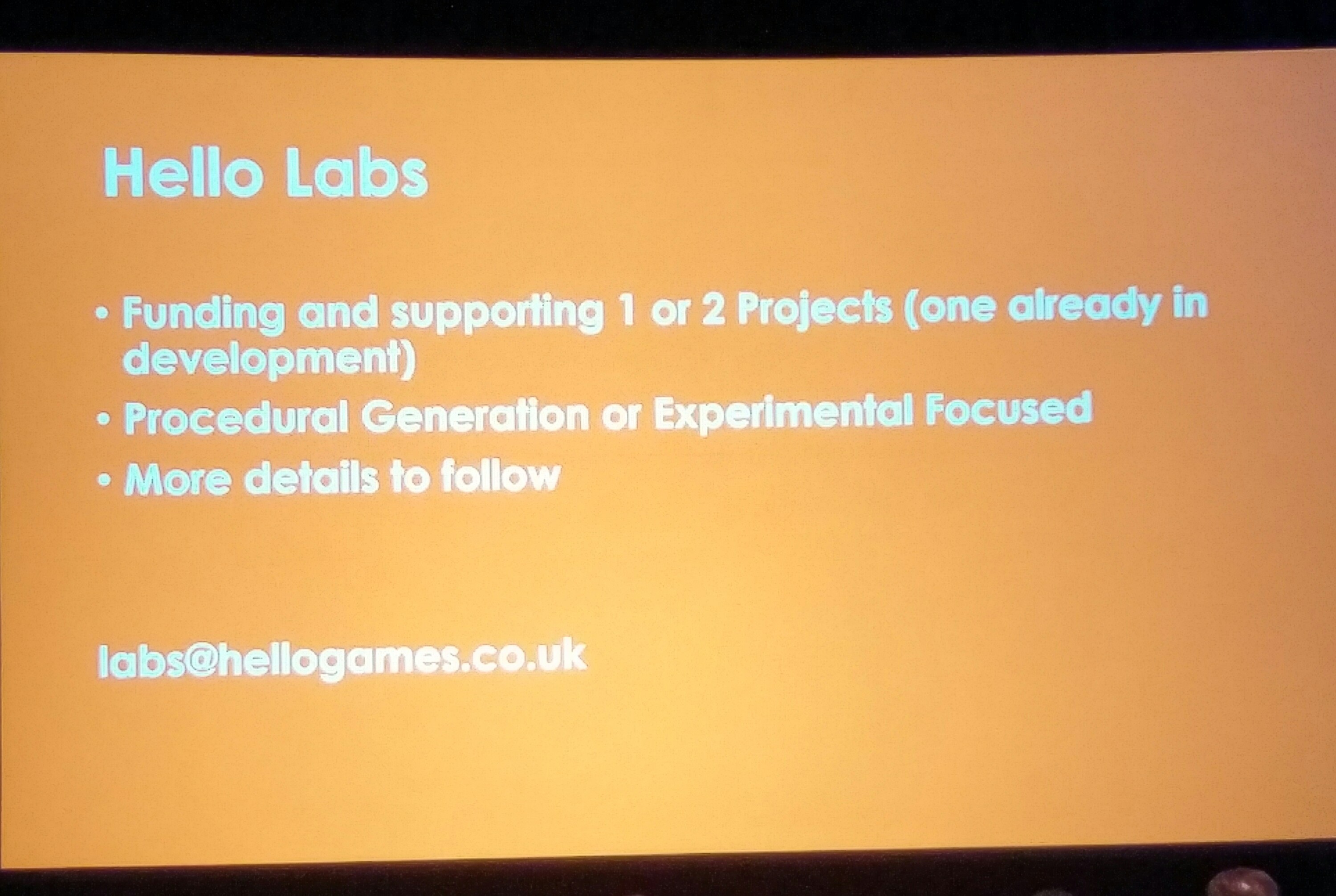
SAN FRANCISCO—Hello Games, the makers of beleaguered space-exploration game No Man's Sky, announced a new initiative on stage at this year's Game Developers Conference: Hello Labs. As announced by studio founder Sean Murray, the company is setting aside money to fund multiple projects—one of which is already in development—that focus on "procedural [world] generation and experimental games research."

Murray made the announcement at the end of a discussion about the use of mathematic formulas to generate the quadrillions of planets in No Man's Sky. This discussion largely avoided talking about the game's mixed critical reception. Still, Murray did point out a few new details about the end of development.

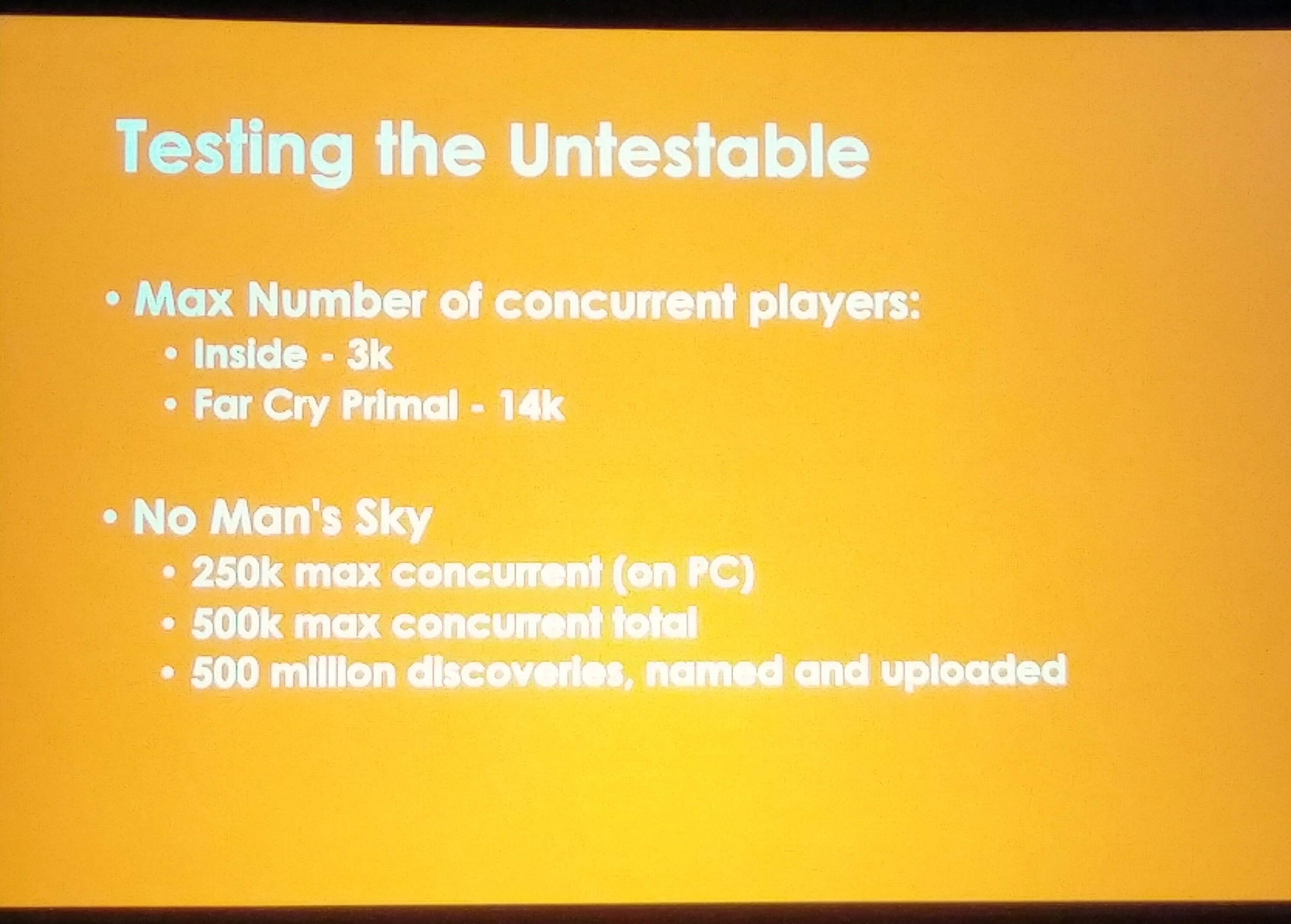
For starters: Murray and his team made an astonishingly low-ball prediction about how many players would boot the game on its first day. As in, less than 14,000. The team considered that number a high-end estimate of concurrent players, because staffers saw that number attached to recent Steam-use data for the game Far Cry: Primal, which launched shortly before No Man's Sky. "It's a huge game, obviously," Murray said. "That [number] made us a little bit nervous about servers and the sheer number of people booting the game up day one." (The team was tempted to estimate even lower, at around the 3,000-player count of indie game Inside, but staffers at Sony warned Murray to estimate something befitting "a triple-A product.")

Read 7 remaining paragraphs | Comments


from No Man’s Sky creator describes issues with launch, crashes, money

Warren Spector almost made an RTS-branded RPG instead of Deus Ex

Thursday, 2 March 2017

Pokémon Go reveals early prototypes, issues with cognitive dissonance

Sam Machkovech

SAN FRANCISCO—The Game Developers Conference has always offered dedicated panels and stages for the biggest mobile games of the moment, so it was no surprise that Pokémon Go, which didn't even exist last March, made an appearance. The game's single panel at this year's event may not have been ripe with tell-alls and behind-the-scenes looks at its every facet, but it still proved a solid look at the phenomenon's early stages.

Niantic Visual Design Director Dennis Hwang was on hand to recall the successes of the developer's prior augmented-reality game, Ingress. That included thousands-strong user meetups organized by players themselves, along with users posting GPS-tracked walks to Ingress points of interest (and saying they lost weight as a result of all that walking). "Our goals initially were modest," Hwang said. "If [our players] just walked a few extra blocks, we would have been totally happy, because we knew how hard it was to motivate someone to get off a chair and move due to some app or game."

Read 8 remaining paragraphs | Comments


from Pokémon Go reveals early prototypes, issues with cognitive dissonance

Wednesday, 1 March 2017

Nintendo used 8-bit Zelda engine to prototype Breath of the Wild

SAN FRANCISCO—Before its retail launch in two days, Legend of Zelda: Breath of the Wild received the spotlight treatment in a Wednesday panel at the annual Game Developers Conference. While explaining the high-level concepts driving new ideas in the highly anticipated sequel, Nintendo developers also revealed a unique prototyping system: a fully playable 8-bit Zelda game.

Three key developers on the game (Hidemaro Fujibayashi, Satoru Takizawa, Takuhiro Dohta) kicked off the presentation by showing an apparent alternate version of the original Legend of Zelda game and asked the crowd to "study" the image, which they said would explain the various elements of its session, dubbed "Change and Constant: Breaking Conventions with Breath of the Wild." It included slight sprite tweaks to the original game, with a thinner, lighter-looking tree, a log on a river's shore, and a clear bottle-shaped icon.

Read 3 remaining paragraphs | Comments


from Nintendo used 8-bit Zelda engine to prototype Breath of the Wild

How indies—and the United States—could save the Nintendo Switch

SAN FRANCISCO—For many games fans, Nintendo has plenty to prove with its Switch console. The biggest issue, arguably, is the flow of new content. The Wii U stopped receiving games much too quickly from first- and third-party creators. That followed more than a decade of pitiful third-party support for other Nintendo systems.

Executives are insisting—yet again—that this time, Nintendo has got it right. But so far, we've mostly heard about Wii U ports and a spread-thin release schedule. Are we already back to déja vú before the new console is even out?

Don't cancel your pre-order yet. In at least one major category, Nintendo just might be getting its act together—and in a giant surprise for longtime Nintendo fans, the company's most promising initiative, and one poised to capitalize on the Switch's strengths, appears to be coming almost entirely from its North American office.

Read 21 remaining paragraphs | Comments


from How indies—and the United States—could save the Nintendo Switch